


Page 2 - Jul-Sep 2008
P. 2
VOL 5 No. 3
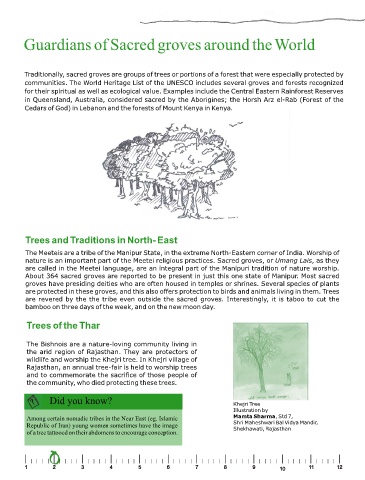
Guardians of Sacred groves around the World
Trees and Myths in Japan
Japan is one of the nations with the highest tree cover. Some Japanese forests are designated as
Traditionally, sacred groves are groups of trees or portions of a forest that were especially protected by Sacred Forests. These forests generally contain an ancient religious Shinto shrine, and are protected
communities. The World Heritage List of the UNESCO includes several groves and forests recognized from trespassers. Forest shrines are still venerated as national treasures.
for their spiritual as well as ecological value. Examples include the Central Eastern Rainforest Reserves
In the Shinto religion of Japan, the sakaki tree (Cleyera japonica) is linked to a creation myth. It is said
in Queensland, Australia, considered sacred by the Aborigines; the Horsh Arz el-Rab (Forest of the that the gods decorated a 500 branched sakaki tree on the heavenly Mount Kaga. On its upper
Cedars of God) in Lebanon and the forests of Mount Kenya in Kenya.
branches they hung a string of 500 jewels, on its middle branches an eight-foot long mirror, and on its
lower branches white and blue offerings. The goddess Amaterasu (who in Japanese mythology is the
Sun goddess) saw her reflection in the mirror hanging from this heavenly Sakaki tree and was drawn
out of her cave and so light was restored both in heaven and on earth. Even, today mirrors are hung on
Sakaki trees at Shinto shrines.
This is a story from a traditional wood sculptor from Kerela.
He said, “We go to the forests and choose an appropriate tree
that is not deformed in any way. Then, on one auspicious day
and hour, we take offerings of sweets and rice and place them
at the foot of the tree. In a prayer, we ask for forgiveness from
all the creatures, birds, and insects that live in the tree. We
Trees and Traditions in North- East assure them that though we are depriving them of their house
The Meeteis are a tribe of the Manipur State, in the extreme North-Eastern corner of India. Worship of and food, we will use the wood for a good purpose, not
nature is an important part of the Meetei religious practices. Sacred groves, or Umang Lais, as they wasting even a scrap of shaving.
are called in the Meetei language, are an integral part of the Manipuri tradition of nature worship.
About 364 sacred groves are reported to be present in just this one state of Manipur. Most sacred
groves have presiding deities who are often housed in temples or shrines. Several species of plants
are protected in these groves, and this also offers protection to birds and animals living in them. Trees
are revered by the the tribe even outside the sacred groves. Interestingly, it is taboo to cut the A favourite tree for each coun-tree!
bamboo on three days of the week, and on the new moon day.
National trees Indian State trees
Trees of the Thar Israel Olive Himachal Pradesh Deodar
China Pine Karnataka Sandal
Russia Birch Punjab Sheesham
The Bishnois are a nature-loving community living in
USA Oak Jharkhand Sal
the arid region of Rajasthan. They are protectors of
wildlife and worship the Khejri tree. In Khejri village of Peru Cinchona Sikkim Rhododendron
Rajasthan, an annual tree-fair is held to worship trees
and to commemorate the sacrifice of those people of
the community, who died protecting these trees. Write down the names of the following trees in your mother-tongue.
Did you know? Khejri Tree Banyan ----------------- Tamarind -----------------
Illustration by
Among certain nomadic tribes in the Near East (eg. Islamic Mamta Sharma, Std 7, Peepal ----------------- Mango -----------------
Republic of Iran) young women sometimes have the image Shri Maheshwari Bal Vidya Mandir,
Shekhawati, Rajasthan Illustration by G. Brinda, Std 9, Sri
of a tree tattooed on their abdomens to encourage conception. Sankara Vidyashramam, Mat Hr. Sec
School, Chennai.
11
1 1 2 2 3 3 4 4 5 5 6 6 7 7 8 8 9 9 10 11 12 1 1 2 2 3 3 4 4 5 5 6 6 7 7 8 8 9 9 10 11 12
12
11
12
10
10

