

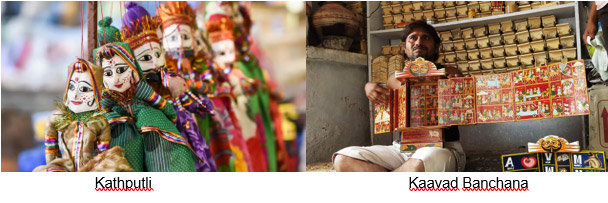
Beloved among children and adults alike are Kathputlis: puppets made of kath or wood, adorned with traditional dresses and ornaments. Their puppeteers, known as Nats or Bhatts, recount Rajasthani folk tales and lores of local heroes through their khel, where marionettes display skills of dance, swordsmanship, instrumental music and acrobatics.
Stories in Rajasthan are also told by artisans who travel with bright boxes. Kaavad Banchana is a four-hundred year old art form. Kaavads, the brightly illustrated wooden boxes, are used by travelling storytellers to narrate tales of gods, saints, local heroes and icons from the Mahabharata or Ramayana. Multiple decorated panels are attached together with hinges, and each tells a new episode of the tale, which could last for hours!

Meenakari, which originates in Jaipur, involves the embellishment of fine jewellery of gold, copper and silver, as well as display furniture made from ceramic, such as vases and serving dishes with intricate designs in vibrant hues. Kundan art and Thewa Kala involve the usage of gold to create traditional jewellery with gemstones and glass. Lac ki chudiyan are bangles made of lacquer, bright in colour and finely decorated by artisans of the Manihar community. Koftgari and Tarakashi involve the usage of silver. An inlay is produced on steel with gold in Koftgari, while wire filigree, a technique of manipulating wires of gold and steel, is used to make elaborate patterns in Tarakashi.
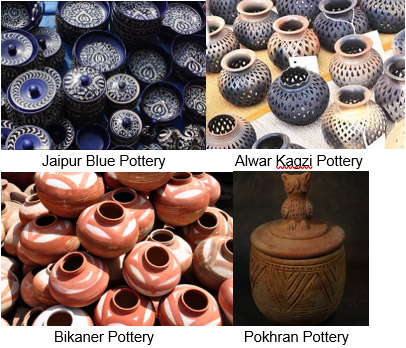
There are several varieties of pottery in Rajasthan, and stylistical distinctions within these wares can be observed across the different areas of production. In Jaipur, the blue glazed pottery offers hand-painted geometric or floral patterns in a mesmerising cobalt hue. Pottery in the capital city does not halt here. It also produces other forms of glazed pottery, and is a leading producer of terracotta pottery. The Alwar district boasts of the oldest form of pottery in the state - the unglazed Kagzi pottery. The paper-thin pots have been crafted in Rajasthan since the medieval era, and are today a rare art. Similarly artisans from the regions of Bikaner and Pokhran create lac-coloured pottery and traditional utensils with carved decorative patterns.
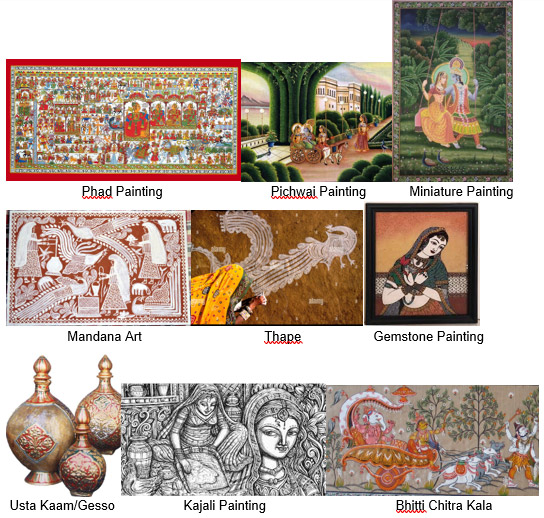
Rajasthani forms of folk art have found appreciation across the world for their bold and vibrant hues, fine details and rich representation of the state's culture. These are often categorised according to their medium, which include cloth, wall and ground, paper, wood and the human body. Phad and Pichwai paintings, which are practised on cloth, and miniature paintings are the most well known, while Manadana art, Thape, Badaley are a few more forms worthy of notice. Classical art in Rajasthan offers striking renditions of Hindu epics and historical figures draped in traditional attires. Gemstone paintings, Usta Kaam, Gesso painting or Nakashi art, Kajali paintings and Bhitti Chitra Kala are some forms of the same.
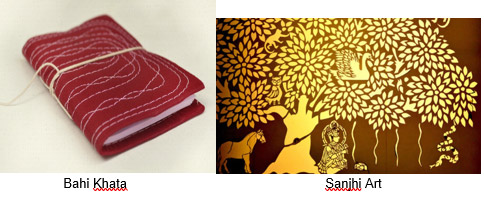
Art in Rajasthan extends to tools for businesspersons! The Bahi Khata are hand-bound ledgers, these books have a distinct wavy pattern on the traditional red cover. Within the cover are yellow and white pages. These ledgers are considered to be auspicious as they are closely associated with the worship of Lakshmi, the goddess of prosperity.
Sanjhi is a traditional art of stencilling, in which intricate motifs and patterns are cut into paper. Although Sanjhi art employs paper differently, this form too is associated with spirituality. The word itself is derived from ‘dusk’, and the art form is an expression of devotional love to Lord Krishna.
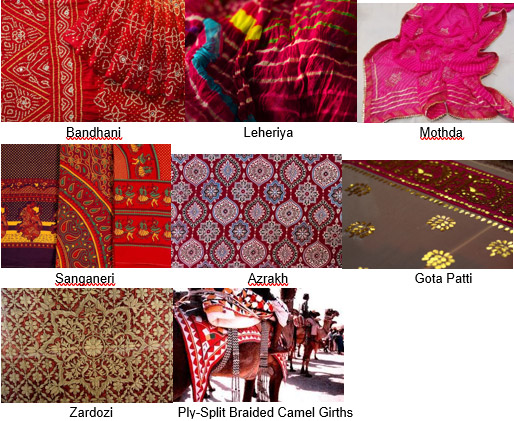
Bandhani or Bandhej is a distinct form of tie and dye native to Rajasthan. Leharia and Mothda are more forms which produce dyed textiles. Methods of hand or block printing on fabric include Sanganeri, Dabu, Bagru or Screen printing, as well as Azola and Azrakh. Embroidery embellishes textiles with bright hues and eye-catching motifs. Gota Patti, Meghwal embroidery, Zardozi, Aari and Badla are some forms of embroidery Rajasthan is famous for. The quilts of Jaipur, ply-split braided camel girths as well as the dhurries, shawls and carpets produced across the state are further displays of weavers and craftspersons collusion in creating wonders of art and textile.


