

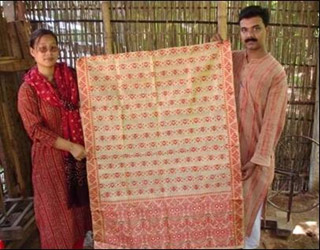
The delicate Assamese silk woven by regional artisans is a work of artistic brilliance. As per the records of Indian history, the knowledge of sericulture migrated from Assam to other parts of India. Muga, Pat, and Eri are three distinct types of silk produced primarily in Assam, each with unique characteristics. Muga Silk is naturally golden-yellow in colour obtained from Antheraea assamensis silkworm. It is known for its durability and glossy texture. Pat is white in colour and obtained from the cocoons of Bombyx mori silkworm which has Fine and soft texture. Eri silk is extracted from Samia ricini silkworm which is soft and warm, with a wool-like feel. It is usually creamy or white in colour, but can be dyed in various colours and it is less shiny than Muga and Pat silks. These silks are used to make sarees and shawls.
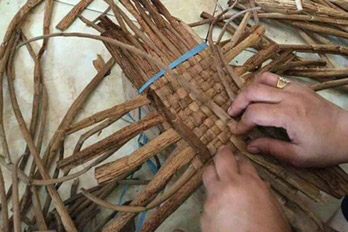
The water hyacinth, which is a commonly found plant species in Assam, grows rapidly in water bodies and slows down the flow of water. Water hyacinths are collected from water bodies where they grow abundantly. The plants are sun-dried to reduce moisture content and prepare the fibres for crafting. The dried stalks are often split into strips. Skilled artisans weave the prepared fibres into various shapes and designs. The products are often worked with additional materials like fabric, leather, or metal to enhance durability and aesthetics. Water hyacinth is often woven into beautiful baskets, furniture, mats, rug and home Decor Items.
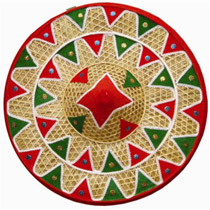
Assam is famous all over the world for bamboo and cane handicrafts. Bamboo is abundant in the region. The indigenous people of Assam have expertise in bamboo craft making. The state is a major exporter of these crafts. They have a whole range of items, including baskets, musical instruments, chairs, weaving accessories, etc. A traditional sunshade of Assam known as “Jappi” is famous across the state. Bamboo and cane handicrafts are also found everywhere across the state. At present, there are vast untapped resources of bamboo that can open avenues for utilisation of bamboo for many productive works. Such a huge surplus of bamboo is not to be found elsewhere in India. The establishment of several pulp and paper plants, big and small, on bamboo alone, is tremendous.
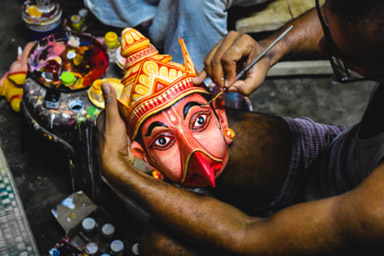
Assam has a rich tradition of the theatrical and dancing arts. The traditional temple dancers in Assam play characters like Bhrama, Yama, Putna, Mura, Narkasura, Jambuvan which are painted into masks. Mask manufacturing originated in Bordhuvan village in the Nangaon region of Assam. The traditional Assamese masks are made from a variety of materials, ranging from terracotta and bamboo to wood, and metals. Two centimetres wide strips of bamboo shoots are cut using a big knife called “Daau” and woven into a hexagonal pattern. Through continuous bending and twisting, a three-dimensional skeleton or ‘hoja’ is acquired. Once the edges are trimmed, soft coconut sap is lined around it to make the mask wearable. Small pieces of cotton cloth dipped in a mixture of cow dung are placed on the skeleton to give that base layer on which facial features are sketched out. Post drying, holes are created for breathing and features like eyes, nose, eyebrows, and lips are inscribed with hands using the cow dung mixture.
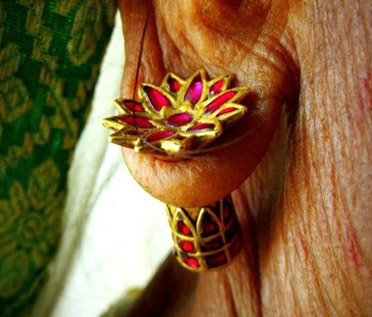
Traditional Assamese jewellery is made with hands by the Assamese artisans. Traditional Assamese jewellery is crafted by a group of Artisans known as “Sonari”. Inspired by nature, most of the styles include motifs of birds, animals, musical instruments such as dhol, drum, pepa, etc. Most of the jewellery styles contain silver and gold foil as their coating. The frame is made with gold and the filling is done with silver. The styles that contain Gold as their base are known as “Kecha Sonar Gahana” or Pat sonar gahana. Once the frame is ready, the jewellery piece is then adorned with kundan and reena stones. Originally, artisans used to embellish the piece with precious gemstones such as rubies, emeralds, and garnets but due to the high cost, the demand for such pieces decreased. However, there are a few Artisans who make jewellery encrusted with precious gemstone.
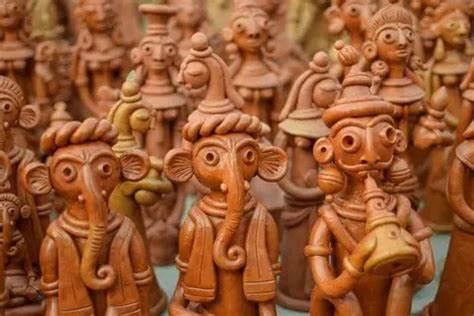
In the early 19th century, some families migrated from the Pabna district of East Bengal (now Bangladesh) to a village in Assam’s Dhubri district. They belonged to the Paul (potter) community and continued with their profession after settling down in the Asharikandi village by the mystic river Gadadhar, a tributary of the Brahmaputra. Over the next 200 years, the families gave a new identity to Asharikandi, which has come to be known as the terracotta and pottery village of Assam. While terracotta refers to an artefact made using clay and fired in a kiln, Then the clay is shaped into terracotta toys, figurines, and kitchenware. In Asharikandi, men, women and even children work together to make terracotta toys, dolls and pottery items which are now sold across India and abroad.
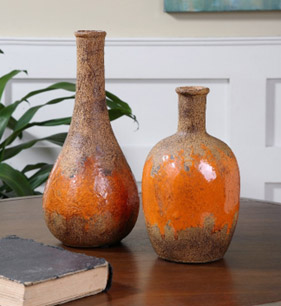
The state has a long history of pottery-making. Assam’s pottery is known for its unique shapes and designs, often inspired by nature and the environment. One of the most popular types of Assamese pottery is the ‘kadam’ pottery. It is known for its distinctive black colour and is often used to create decorative items such as vases, bowls, and plates. Another popular type of Assam pottery is the ‘Manohari’ pottery, made using red clay and known for its intricate designs and patterns. It is often used to create tea sets and other kitchenware. Assam’s pottery is also famous for its use in traditional Assamese rituals and ceremonies. For example, the ‘Bhelaghar’ is a traditional Assamese clay lamp used during festivals and religious ceremonies. Pottery reflects Assamese people’s creativity, ingenuity, and connection to the natural environment.
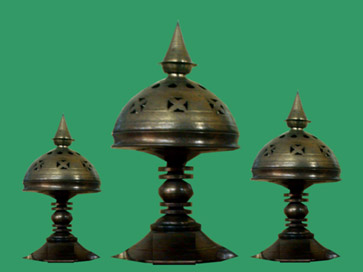
Bell-metal and brass have been the most used metals for the Assamese artisan. Traditional utensils and fancy articles designed by these artisans are found in every Assamese household. The Xorai and Bota are in use for centuries, to offer betel-nut and paan while welcoming distinguished guests, Xorai is particularly used to give offerings to the goddess during Durga pooja, during the ceremonies in Namghar and during Assamese weddings. The entire population of two townships near Guwahati named Hajo and Sarthe Bari, are engaged in producing traditional bell-metal and brass articles. They have also used their innovative skills to design modern day articles to compete with the changing times. Gold, silver and copper too form a part of traditional metal craft in Assam and the State Museum in Guwahati has a rich collection of items made of these metals.
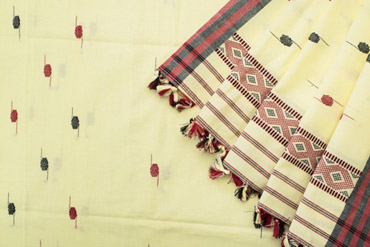
The Mekhela Chador is a mesmerizing and timeless traditional garment that holds immense cultural significance in the beautiful region of Assam. Hand-woven with precision and skill, this two-piece attire showcases the rich heritage and craftsmanship of Assamese textiles. Mekhela is the lower piece of the garment which is gracefully wrapped around the waist, much like a skirt. The Chador, also known as Cheleng, is the upper portion of the mekhela chador. The Mekhela Chador is crafted using various types of silk, giving rise to different variants. It is mainly crafted in the town called Sualkuchi in Assam. The Mekhela Chador is not merely a garment, it is a symbol of tradition, elegance, and ethnic pride.
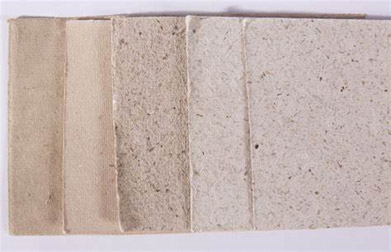
Assam is home to the world’s largest population of one-horned rhinos. Rhino’s dung is utilised to produce paper which is a unique and eco-friendly innovation from Assam. Rhino dung is collected from areas like Kazi Ranga National Park, which is home to a significant population of one-horned rhinos then the fibrous content in the dung is separated and processed. The fibre is then spread on screens and left to dry, forming sheets of paper. The paper can be used for making various paper products like notebooks, greeting cards, and gift wraps. This paper production is primarily done by “ElRhino” factory. This innovation utilises waste material which promotes recycling and sustainable use of natural resources.


